Thursday, February 19, 2009

"Glorious" developement under Hun Sen's regime ... as seen through the lense of AP photographer David Longstreath


Caution: Prolonged exposures to these photos will make you become complacent to poverty in Cambodia. This is most likely the case for all those in the current ruling CPP regime, including those living or working in the modern buildings nearby.

A young Cambodian woman rides a bicycle near slum homes Thursday, Feb. 19, 2009, on the outskirts of Phnom Penh, Cambodia. According to government sources an estimated 35 percent of Cambodians live under the poverty line. (AP Photo/David Longstreath)
Young Cambodian girls play near their slum home Thursday, Feb. 19, 2009, on the outskirts of Phnom Penh, Cambodia. According to government sources an estimated 35 percent of Cambodians live under the poverty line while more than 30 percent of the population is under the age of 15. (AP Photo/David Longstreath)
A Cambodian bathees near his slum home Thursday, Feb. 19, 2009, on the outskirts of Phnom Penh, Cambodia. According to government sources an estimated 35 percent of Cambodians live under the poverty line. (AP Photo/David Longstreath)
Cambodian children play inside their slum home Thursday, Feb. 19, 2009, on the outskirts of Phnom Penh, Phnom Penh, Cambodia. According to government sources an estimated 35 percent of Cambodians live under the poverty line. In 1975 the Khmer Rouge emptied the cities in an attempt to create an agrarian communist society killing off political opposition, Buddhist monks and the vast majority of the population's educated people. After four years the Khmer Rouge killed or worked to death an estimated 1.7 million people. Today more than 30 percent of the population is under the age of 15. (AP Photo/David Longstreath)
Cambodian women gather near their slum homes Thursday, Feb. 19, 2009, on the outskirts of Phnom Penh, Phnom Penh, Cambodia. According to government figures less than four percent of Cambodia's 14 million people are over the age of 65. Many blame the low figure on the massacres committed by the Khmer Rouge which left more that 1.5 million Cambodians dead during their reign from 1975 to 1979. Today trials of the former leaders have officially begun. (AP Photo/David Longstreath)
An elderly Cambodian man pushes his bicycle near his slum dwelling Thursday, Feb. 19, 2009, on the outskirts of Phnom Penh, Cambodia. According to government figures less than four percent of Cambodia's 14 million people are over the age of 65. Many blame the low figure on the massacres committed by the Khmer Rouge which left more that 1.5 million Cambodians dead during their reign from 1975 to 1979. Today trials of the former leaders have officially begun. (AP Photo/David Longstreath)
Cambodian children play a game of 'marbles' near their slum home Thursday, Feb. 19, 2009, on the outskirts of Phnom Penh, Cambodia. According to government sources an estimated 35 percent of Cambodians live under the poverty line. In 1975 the Khmer Rouge emptied the cities in an attempt to create an agrarian communist society killing off political opposition, Buddhist monks and the vast majority of the population's educated people. After four years the Khmer Rouge killed or worked to death an estimated 1.7 million people. Today more than 30 percent of the population is under the age of 15. (AP Photo/David Longstreath)
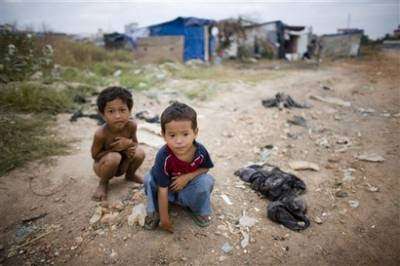
Young Cambodian boys play near their slum home Thursday, Feb. 19, 2009, on the outskirts of Phnom Penh, Cambodia. According to government sources an estimated 35 percent of Cambodians live under the poverty line. In 1975 the Khmer Rouge emptied the cities in an attempt to create an agrarian communist society killing off political opposition, Buddhist monks and the vast majority of the population's educated people. After four years the Khmer Rouge killed or worked to death an estimated 1.7 million people. Today more than 30 percent of the population is under the age of 15. (AP Photo/David Longstreath)


Wednesday, February 18, 2009

Americans Also Buried in Cambodia's Killing Fields


Tuol Sleng's victims were shoved into 100 mass graves and skeleton-packed pits on the outskirts of Phnom Penh, which were later marked with signs after the Khmer Rouge were ousted (Photo © by Richard S. Ehrlich)
"They are murderous thugs, but we won't let that stand in our way," Henry Kissinger told Thailand. (Photo © by Richard S. Ehrlich)
The interior of a narrow make-shift cell in Tuol Sleng S-21 prison. (Photo © by Richard S. Ehrlich)
The door to a narrow make-shift cell in Tuol Sleng S-21 prison. (Photo © by Richard S. Ehrlich)
A painting by former prisoner Vann Nath, who later documented Tuol Sleng's slitting of throats during interrogation. (Photo © by Richard S. Ehrlich)
A painting by former prisoner Vann Nath, who later documented Tuol Sleng's use of pliers during interrogations. (Photo © by Richard S. Ehrlich)
A painting by former prisoner Vann Nath, who later documented Tuol Sleng's style of water boarding during interrogations. (Photo © by Richard S. Ehrlich)
A painting by former prisoner Vann Nath, who later documented Tuol Sleng's beatings during interrogations. (Photo © by Richard S. Ehrlich)
A Cambodian girl photographed by officials at Tuol Sleng with her arms tied behind her before interrogation. (Photo © by Richard S. Ehrlich)
A Cambodian woman and baby photographed by officials at Tuol Sleng on May 14, 1978 before interrogation. (Photo © by Richard S. Ehrlich)
A young Cambodian man photographed by officials at Tuol Sleng during interrogation. (Photo © by Richard S. Ehrlich)

Thursday, 19 February 2009

Richard S. Ehrlich
Scoop.co.nz (New Zealand)

Tortured Americans Also Buried in Cambodia's "Killing Fields"

BANGKOK, Thailand -- An estimated 1.7 million corpses are rotting in Cambodia's "killing fields," including two Americans from California and Minneapolis, whose blank-faced alleged torturer appeared in court on Tuesday (February 17) at the start of a U.N.- backed international tribunal.
"One Cambodian government document found in the National Archives of Cambodia revealed that an American, Michael Deeds, was taken to the notorious Tuol Sleng S-21 prison, tortured, and then executed during the last days of the Khmer Rouge government regime in Cambodia in 1979," wrote American investigators connected to the U.S. Defense Department.

"He was then buried behind Tuol Sleng," said the Defense POW/ Missing Personnel Office (DPMO), which searched among dusty files in 2000, unable to find further leads to determine what happened to the Americans.

Mr. Deeds, who went to high school in Long Beach, California, was seized by the Khmer Rouge along with others on a boat near Cambodia's coast.

He was travelling with James William Clark of Minneapolis, who was also interrogated in Tuol Sleng and died.

The burial ground for Tuol Sleng's victims includes 100 mass graves and skeleton-packed pits on the outskirts of Cambodia's capital, Phnom Penh.

Nearby, the U.N. tribunal began its long-awaited hearings by displaying the elderly former Khmer Rouge torturer and interrogator, Kaing Guek Eav, commonly known as Duch (pronounced "Doyk").

Facing judges, lawyers, survivors, investigators and others, Duch stared wide-eyed and mostly expressionless while the court went through dry preparations to hear Duch's testimony, expected in March.

Duch operated Tuol Sleng where victims suffered water boarding, beatings, throat slitting, extraction of body parts with pliers, hanging, and other horrific abuse, according to former prisoner Vann Nath, who later documented the acts in gruesome paintings.

Duch has partially confessed, and his testimony would provide valuable details about what went on when Pol Pot's Khmer Rouge ruled Cambodia from 1975-79.

The Khmer Rouge's victory came when they toppled Cambodia's U.S.- backed Lon Nol regime in 1975, at the end of Southeast Asia's regional Vietnam War, which America lost in Vietnam, Cambodia and Laos.

An estimated 1.7 million Cambodians perished under the Khmer Rouge's reign, which crumbled when a newly united Vietnam invaded impoverished Cambodia.

Duch, however, may not be able to offer much help in locating the remains of the Americans, or anyone else, because when Tuol Sleng's 16,000 tortured victims were dragged away, they were shoved by other Khmer Rouge cadres into unmarked graves.

The document about Mr. Deeds was described by the DPMO team as requesting "the disposition of Deeds, while in Tuol Sleng prison in late 1978, before the Pol Pot regime had him executed.

"Deeds was one of four Americans allegedly killed while possibly smuggling marijuana from Thailand, when their ship went off course and ended up in Cambodian waters, where they were boarded by Khmer Rouge and captured," said the U.S. team.

"Michael Scott Deeds, 29 years old, male, spy of Americans," reads a brief identification tag dated November 26, 1978, according to a separate Tuol Sleng Catalogue of Confessions compiled by Cornell University.

Tuol Sleng's interrogators extracted confessions from people who were tortured until they spouted the names of relatives, friends, associates, officials, strangers, and anyone else they could think of.

In agony, victims told whatever incriminating stories they thought would please their tormentors -- apparently hoping to end the pain or escape execution.

To prove their rapid, conveyor belt system of interrogations was efficient, Tuol Sleng's officials presented them as fact.

As a result, other Khmer Rouge believed the confessions, and brought in more and more innocent victims.

They, in turn, incriminated others in an increasingly absurd and vicious spiral which quickly decimated the government and its supporters.

Khmer Rouge loyalists, patriots and enthusiastic cadres soon found themselves scheduled for execution, based on Tuol Sleng's hand- written and typed dossiers.

America was castigated as Cambodia's worst enemy, and frequently appeared in confession statements.

But Washington was secretly covering up, and trying to improve, America's relations with Pol Pot's Khmer Rouge regime.

"You should also tell the Cambodians that we will be friends with them," U.S. Secretary of State Henry Kissinger told Thailand's political and military officials in Washington on November 26, 1975, seven months after Pol Pot seized power.

"They are murderous thugs, but we won't let that stand in our way. We are prepared to improve relations with them," Mr. Kissinger said according to a recently declassified U.S. State Department transcript.

"Tell them the latter part, but don't tell them what I said before," Mr. Kissinger told Thailand's U.S.-backed Foreign Minister Chatichai Choonhavan and his delegation -- three years before the confessions were extracted from Mr. Deeds and Mr. Clark at Tuol Sleng.

In 1989, Mr. Deeds's brother traveled to Tuol Sleng, but was unable to find his remains.

*************
Richard S Ehrlich is a Bangkok-based journalist who has reported news from Asia since 1978. He is co-author of "Hello My Big Big Honey!", a non-fiction book of investigative journalism, and his web page is http://www.geocities.com/asia_correspondent

WHO warns of a growing male AIDS crisis


2009/02/19
By Annie Freeda Cruezannie
fc@nst.com.my
New Straits Times (Malaysia)

KUALA LUMPUR: The World Health Organisation has warned that the HIV/AIDS epidemic may take a turn for the worse in Asia unless countries urgently expand access to health services for men who have sex with men.

WHO regional adviser on HIV/AIDS and sexually transmitted infection Dr Massimo Ghidinelli said evidence showed that unprotected male-to-male sex was again fuelling the spread of the disease.

"Studies show that at present, the proportion of HIV infections being transmitted among men who have sex with men is larger and more significant than we had originally believed," he said in a statement.
This re-emerging mode of transmission has prompted WHO's Regional Office for the Western Pacific, in collaboration with the United Nations Development Programme, and the Hong Kong Department of Health, to call for swift action to address this growing health crisis.

The organisers have started meeting with HIV/AIDS specialists from Asian governments, regional experts and representatives from non-governmental organisations since yesterday to discuss strategies to deliver better services to MSM communities.

Countries participating in the conference in Hong Kong are Australia, Cambodia, China, Fiji, Hong Kong, Japan, Laos, Malaysia, Mongolia, New Zealand, the Philippines, Singapore and Vietnam.

Dr Ghidinelli said strengthening surveillance and implementing effective interventions for HIV prevention and care among men having sex with men should be prioritised to prevent the further spread of the virus.

A review in December 2007 showed that in Cambodia and Vietnam, men who have sex with men are more likely to contract HIV compared with the general population.

In China , the risk of infection by men who have sex with men is 45 times higher than for men in general. Asia is believed to have the world's largest number of men having sex with men, estimated at 10 million.

Dr Ghidinelli said the lack of better access to HIV/AIDS services can be traced to the stigma and discrimination associated with male-to-male sex, which is frowned upon in some societies, and to breaches of human rights, including the right to better health.